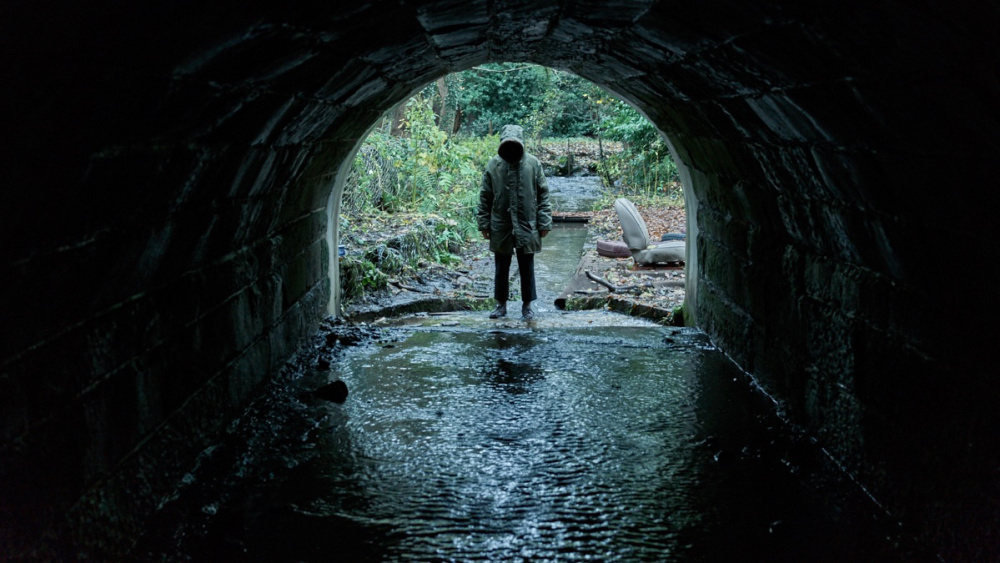
The Miskatonic Institute of Horror Studies and the Motel X International Horror Film Festival welcome Andy Nyman, co-writer/director of the chilling and unsettling new British film Ghost Stories, in a discussion moderated by Stephen Thrower.
Ghost Stories began life as a stage play written by Nyman and The League of Gentlemen‘s Jeremy Dyson, which premiered at the Liverpool Playhouse in 2010 before transferring to London for a year’s run at the Duke of York Theatre. Their successful film version opened at the London Film Festival in 2017. The project sees the confluence of two artistic influences: the British ghost story tradition, and the Amicus portmanteau horror films of the 1960s and 1970s. From these elements, Dyson and Nyman have created a story that engages with some of the deeper currents of the supernatural tradition: belief vs. doubt, psychological explanations vs. supernatural explanations, and the role of traumatic guilt in shaping a person’s outlook and character. These rich themes are present in many of the best British ghost stories and find a vivid echo in Dyson and Nyman’s storytelling.
Topics of discussion will include the process of adapting a stage play to the screen, the different challenges inherent in scaring a live audience vs. a cinema audience, and the personal journeys of the two writers in realising their project, first as a stage play and then as a movie. Discussion will also delve into the storytelling traditions from which the film draws, and the techniques employed by horror filmmakers to frighten or disturb the viewer. For instance, pivotal to Ghost Stories is the notion of scepticism, a feature of many classic ghost stories in which the protagonist is frequently someone who does not believe in the supernatural. Why is the sceptic such an important figure in ghost stories? How is it that one can scare or unsettle an audience who do not always believe in the premise of the fiction? Do psychological readings of classic ghost stories distort the text, or are the stories ripe for interpretation along such lines? What makes the short story (and the portmanteau film format) so well suited to the horror genre? And given the nature of cinema, in which the demand is for things to be seen, how can filmmakers retain the element of ambiguity or uncertainty, an element that is so important to the creation of uncanny moods in literary ghost stories?
Since 2001, Andy Nyman has worked in close collaboration with psychological illusionist Derren Brown, conceiving and writing his hugely popular stage and TV spectaculars: these sometimes shocking and controversial shows gleefully manipulate the forces that shape an audience’s perception of reality. What is it that draws he and his collaborator Jeremy Dyson to dark and horrific subject matter? And in what way does their black sense of humour counterpoint their taste for the nightmarish and disturbing?
Stephen Thrower, writer and musician, was born in Lancashire in 1963. After moving to London in 1985 he began writing reviews for the seminal horror magazine Shock Xpress, before launching his own film periodical Eyeball in 1989 with contributors including novelist Ramsey Campbell, filmmaker Ron Peck, and critics Kim Newman, Daniel Bird and Alan Jones. His first book, Beyond Terror: The Films of Lucio Fulci, was published in 1999, followed by The Eyeball Compendium (2003) and Nightmare USA: The Untold Story of the Exploitation Independents (2007). His most recent work is Murderous Passions; the delirious cinema of Jesús Franco, published by Strange Attractor in March 2015.
Thrower and his partner Ossian Brown are founders of the avant-garde music group Cyclobe, who recently recorded new soundtracks for three Super-8 films by the British filmmaker and queer activist Derek Jarman (Sulphur, Tarot and Garden of Luxor). As a solo artist, Thrower scored Pakistan’s first gore film, Zibahkhana aka Hell’s Ground (2007), contributed electronic music to Down Terrace (2010) by Ben Wheatley, and was commissioned by the BFI in 2012 to score three silent short films by the pioneering director of gay erotica Peter De Rome.