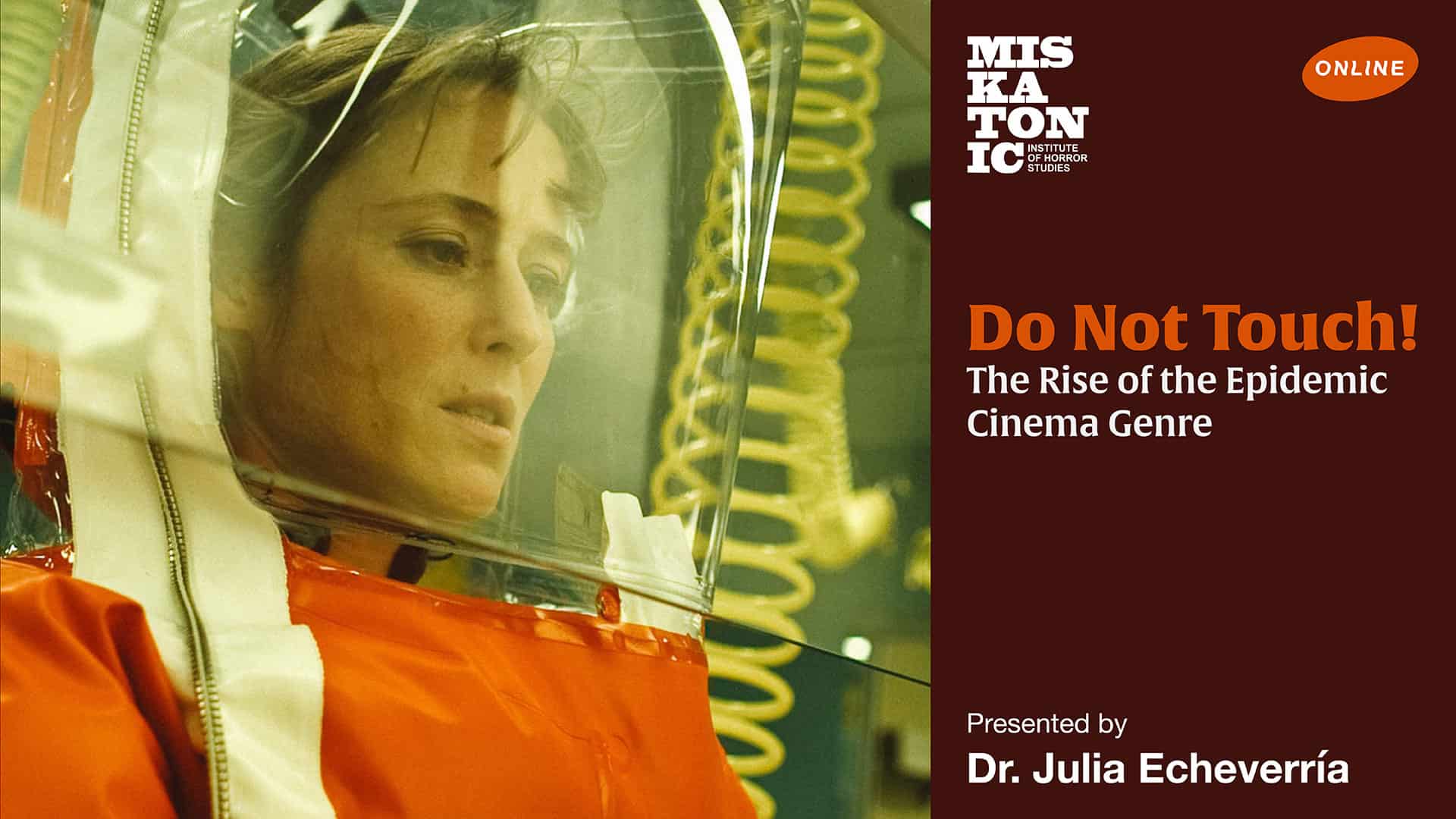
“There have been as many plagues as wars in history; yet always plagues and wars take people equally by surprise.” These words from Albert Camus’s The Plague underscore the unpredictable nature of pandemics. And yet, long before the COVID-19 crisis, popular cinema was issuing repeated warnings about the threat of viral outbreaks in the age of global mobility. From zombie apocalypses to deadly contagions, the early twenty-first century saw an unprecedented proliferation of fictional narratives centered on highly transmissible pathogens, building on past epidemic scares and anticipating future health crises.
In this lecture, Dr. Julia Echeverría explores the emergence of the “epidemic film” as a distinct genre, outlining its key stylistic, thematic, and narrative conventions. She offers a historical overview of its cinematic development and proposes a typology of epidemic narratives into three tales: connectivity, confinement, and conversion. The lecture also examines the pervasive use of contagion as a metaphor in contemporary popular culture, a recurring motif symptomatic of increasingly invisible, transnational, and deterritorialized threats. Epidemic films foreground a wide range of discourses relating to borders, global risk, biopolitics, digital networks, and forms of social contagion. These narratives dramatize the conflict between homogenizing global threats and the desire to preserve individuality, oscillating between collective panic and individual fright, between public health and the intimacy of bodies, and between global interconnectedness and nationalist resistance.
Dr. Julia Echeverría will perform close readings of CHILDREN OF MEN (Alfonso Cuarón, 2006), BLINDNESS (Fernando Meirelles, 2008), CONTAGION (Steven Soderbergh, 2011), and WARM BODIES (Jonathan Levine, 2013), among others, to illustrate the evolution and cultural significance of epidemic cinema in the twenty-first century. In a world where conspiracy theories and mistrust of modern medicine spread like the proverbial plague, this talk could not be more timely.
Dr. Julia Echeverría is an Associate Professor of English Studies at the University of Zaragoza, Spain. She is the author of Epidemic Cinema: The Rise of a Genre (Routledge, 2024) and has published academic articles and book chapters on the epidemic horror genre, transnational filmmakers such as Alfonso Cuarón and Guillermo del Toro, and female prison television series from a cosmopolitan perspective. She is also co-editor of Cosmopolitan Aspirations in Contemporary Cinema (Routledge, 2025), alongside María del Mar Azcona and Pablo Gómez-Muñoz. Her current research focuses on the representation of spaces and places in the cinema of Yorgos Lanthimos.