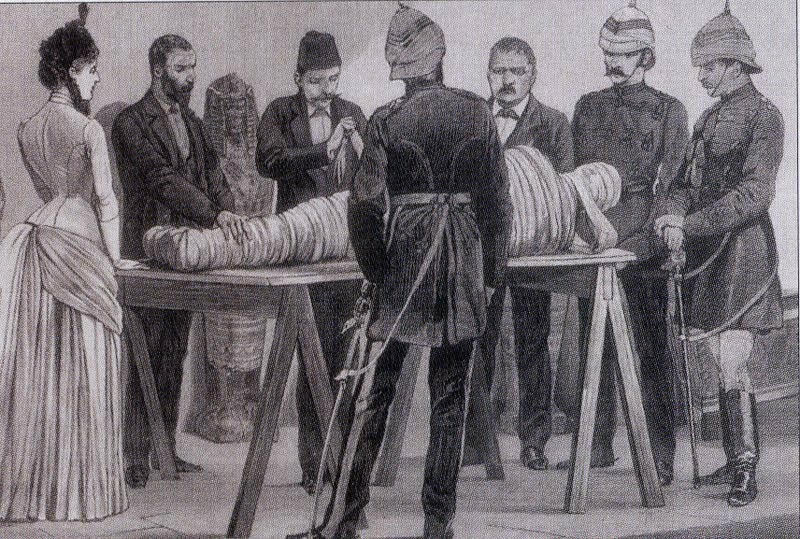
If you have ever seen an ancient Egyptian mummy, apart from in a film, it is likely you saw one in a museum. There is usually some information attached to the exhibit, a note where the mummy was found, their age, perhaps even a name. However, have you ever wondered; how did it arrive there? If it was ‘acquired’ during the nineteenth century, likely it was either ‘legally stolen’ (through the loophole of colonialism) or illegally smuggled. Either way: you are looking at a stolen corpse on display for all to see.
This lecture aims to unravel the history of mummies and the ‘mummy’s curse’ by focusing on their treatment and perception in the nineteenth-century. It will focus on the consequences of the mummy-trade in nineteenth-century Britain focusing on how mummies were perceived and treated during this time. There are four specific areas that will be examined; mummy pits (mass tombs and Victorian descriptions of pits, visual culture); mummies on display (mummy unwrapping parties); Victorian mummy Gothic fictions (by Bram Stoker, H. P. Lovecraft, Arthur Conan Doyle and Louisa May Alcott); and mummies in media (early horror films featuring mummies and their connection to museums).
I focus on key case studies, exhibitions, and events to demonstrate the overall, (and some important individual) perceptions of the mummy, and how this unethical treatment shaped the idea of the mummy in modern society. What does it mean to be human? How can we honour mummies by focusing on the very thing that makes them terrifying? How did the perceptions of the mummy create a Gothic monster? How did mummy fiction in the nineteenth-century contribute to the figure of the mummy? What is the relationship between horror and mummies beyond the media? And how can examining the past create a more ethical and respectful future for mummies?
By the end of the lecture, attendees will have a wider understanding of this under-researched area of history, and develop an appreciation for the history surrounding mummies. Additionally, attendees will gain an insight into how mummy fictions and films perceive mummies as the ‘villain’/’monster’ and how the mummy figure bridges the gap between history and horror through various mediums. Furthermore, this conversation extends to the wider debate surrounding human remains in museums, a current and significant discussion regarding decolonisation, and (un)ethical displays.
Rebecca Bruce is a PhD student focusing on the unethical treatment and perception of mummies in nineteenth-century Britain. She focuses on the concept of ‘travel and the body,’ examining travel narratives, visual and material culture, mummy unwrappings, the display of human remains, and mummies in museums to develop a wider understanding of how the mummy was viewed during Victorian Britain. Bruce is the creator of Mummymania Mondays, a social media presence about mummies in history. She is also the creator and editor of The Anatomy Shelf, a free monthly newsletter focusing on the body in history literature and art. She is also the host of The Anatomy Shelf podcast (coming soon). In her spare time, she is also a gothic and horror writer and journalist working with publishers, authors and studios to promote their work (books and films). She has interviewed many horror icons such as Grady Hendrix, Ramsey Campbell, and Beverley Lee, and has forthcoming interviews with Sean Hogan, Tim Lebbon, and Stephen Volk. She has written popular articles including ‘Unfinished Business: Reading the Fragmented Ghost Stories of William Gay,’ Midwich Mayhem: How The Simpsons resurfaced a forgotten horror classic of the 1950s,’and has an article on mummy-brown paint in press for ArtUK.org. In May 2022, she curated an exhibition on Dracula, ‘a maritime history’ to mark the novel’s 125th anniversary. Additionally, she is the co-founder and co-chair of ISSE, The International Society for the Study of Egyptomania. In recent years, she has presented papers on mummies, gothic and horror studies, fiction, non-fiction, and the Victorians and mummymania.