PLEASE NOTE that this class begins at 3pm EST. All other classes in the series have the usual start time of 2pm EST. If you cannot make the livestream, please email us within a day of the event, and we will send you a link to a recording.
For horror critics and fans, conventional wisdom suggests that practical special effects are superior to their digital counterparts because of their clear material connection to the human performer. They have weight and take up space, in opposition to the ephemeral computer-generated images unconvincingly inserted into a film during post-production. However, this conventional wisdom relies upon a hierarchical understanding of technology as inferior to and separate from the human body. Instead of conceptualizing prosthetic effects as tools that merely augment or obscure a performer’s ‘true’ self, this talk explores the potential of these technologies to rework and transform the human form.
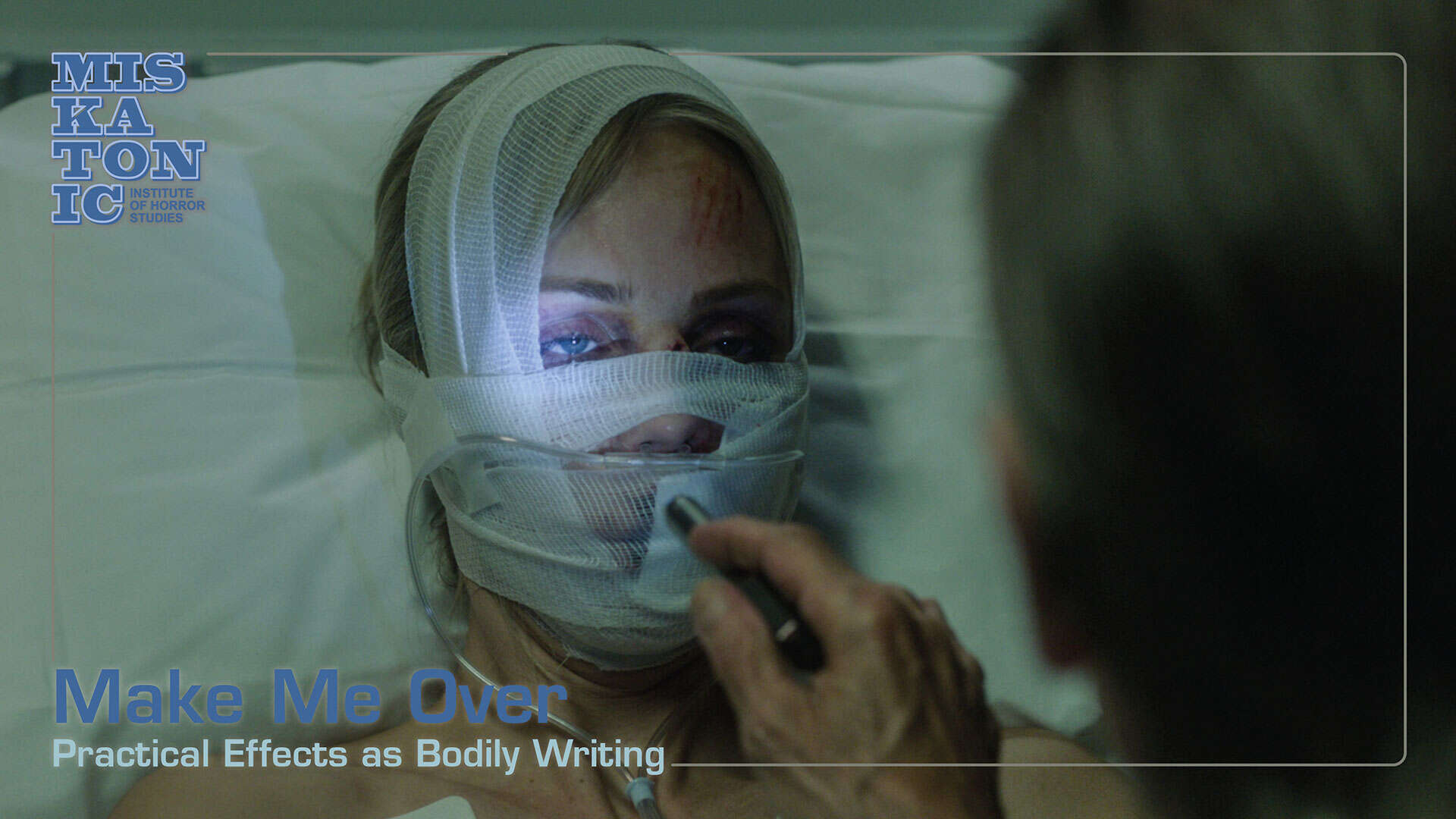
While digital effects are more frequently associated with the ability to morph and alter a performer’s appearance, horror scholar Sarah Woodstock talk argues for the capacity of practical effects to serve as the medium for the material realization of a new body. Her lecture draws on the work of philosopher Jacques Derrida to conceptualize practical special effects as a mode of writing, with a capacity for creation and (re-)inscription that is unbound from any single referent or origin. The argument will focus primarily on two films that center bodily transformation: While Sam Raimi’s DARKMAN (1990) follows a man who tries and fails to recover from a disfiguring accident through prosthetic technologies, the Soska Sisters’ AMERICAN MARY (2012) demonstrates the extreme malleability of the human form through elective surgery.
Each of these films focus on bodies transformed through practical effects (alongside computer generated imagery and, in American Mary, actors with real-life body modifications) but offer strikingly divergent accounts of the potential of these effects as a form of writing. DARKMAN insists on the altered body’s inferiority to its past self, while AMERICAN MARY pointedly refuses this hierarchical construction. Through these two examples, among others, this talk considers latex and plaster alongside bone, sinew, and flesh as potential materials for writing and meaning-making, ultimately advocating for an understanding of the body as continually open to change, untethered from any singular, preset form.
Sarah Woodstock is a PhD candidate in Screen Cultures and Curatorial Studies at Queen’s University. Her research focuses on true crime media, with an emphasis on the figure of the serial killer. Her work has appeared in Flow, Crime Fiction Studies, and Rue Morgue.