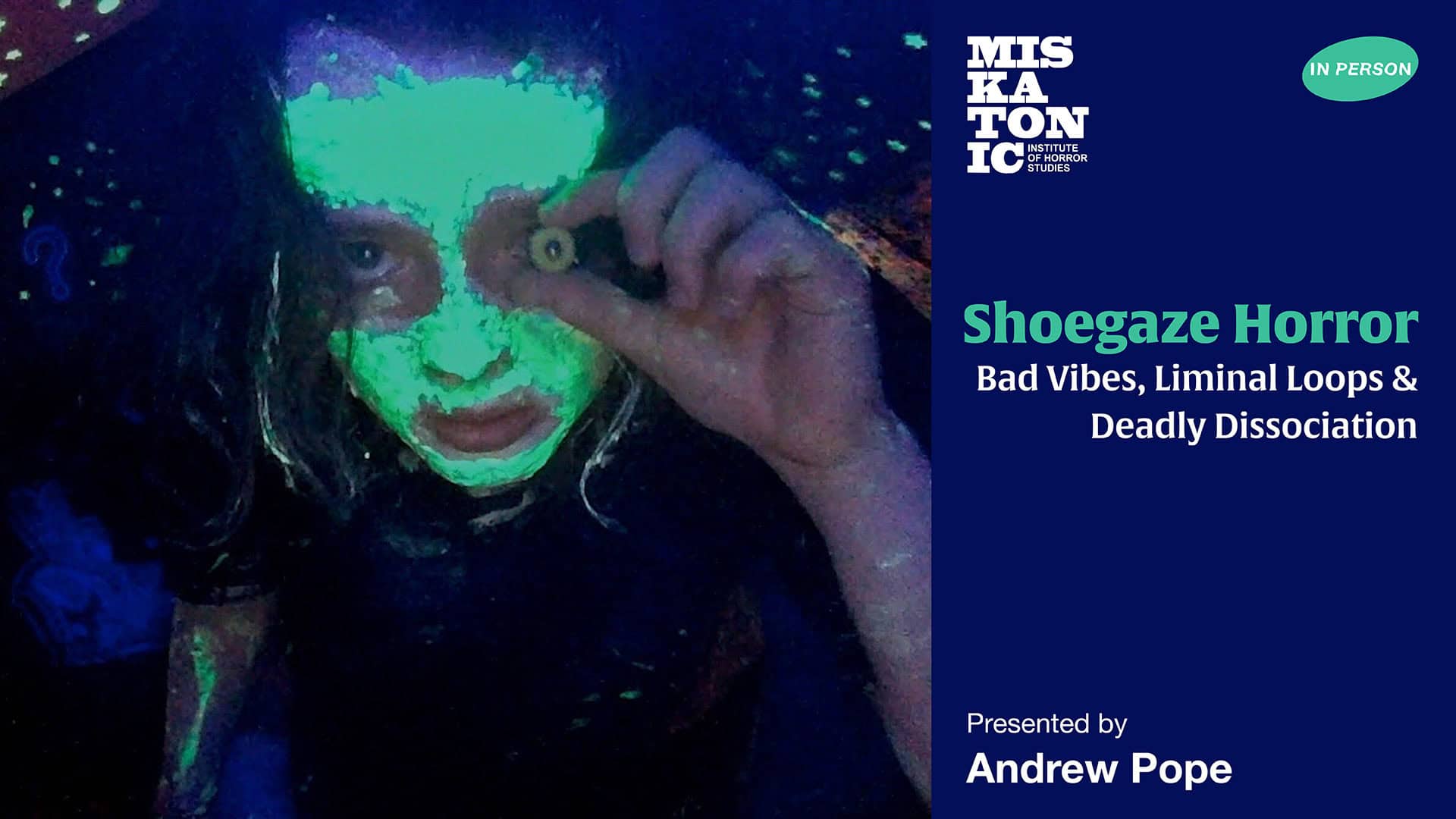
In this lecture, we’ll immerse ourselves in the dreamlike, destabilising atmosphere of Shoegaze Horror—a form of horror cinema that seemingly swaps story for sensation, jump-scares for stillness, and clear answers for ambiguous dread.
Named after the 1990s music genre known for layered distortion, emotional opacity, and immersive soundscapes, Shoegaze Horror is cinema at the edge of coherence. It evokes fear not through jump scares or gore, but through repetition, oblique imagery, liminal spaces, and a slow emotional drift into disconnection. Over 90 minutes, this lecture will chart the emergence, form, and themes of Shoegaze Horror through a core set of films and wider cinematic genealogy.
We’ll trace a genre defined by absence, distortion, and the ghostly echo of dead futures, and:
- Introduce the notion of Shoegaze Horror through its core cinematic strategies
- Explore the genre’s central themes: grief, memory, alienation, and emotional paralysis.
- Examine how Shoegaze Horror reflects contemporary cultural and psychological conditions—particularly post-financial crisis social drift and pandemic-induced dissociation and disconnection.
- Analyse key case studies and identify recurring formal elements across a diverse spectrum of films.
We’ll focus on three films in particular:
Using Beyond the Black Rainbow (2010) as a formal gateway, we’ll explore how Shoegaze Horror builds dread through sensory overload, ambient sound, and retro-futuristic melancholy.
In We’re All Going to the World’s Fair (2021), the genre meets the internet age: alienation, identity erosion, and disembodied transformation through low-res intimacy and ambient dread.
Skinamarink (2022) becomes our guide to childhood fear, abstract space, and temporal stasis—illustrating how Shoegaze Horror turns the home into a liminal, haunted, formless void.
Through these films and others, we’ll map out this genre movement and its five key aspects: ambiguity; stillness; repetition; liminality; and auditory dread.
We’ll also be asking: why now – what does this trend in horror cinema tell us about our culture and concerns? What are the psychological aspects of Shoegaze Horror? How does it differ from Folk Horror and Cosmic Horror? And where does it come from – what are the roots and precursors of this approach to horror, from Maya Deren and Jean Rollin to David Lynch and Kiyoshi Kurosawa?
Andrew Pope is a critic and writer exploring the emotional architectures of genre cinema. Their work focuses on the aesthetics of disconnection, narrative ambiguity, and the intersection of mood and meaning in horror. They co-edit the online film journal Whitlock & Pope, have presented at the London Horror Symposium, and have contributed to Sight and Sound and Horrified magazines. Currently, Andrew is developing a project on horror and the cinema of dissociation.