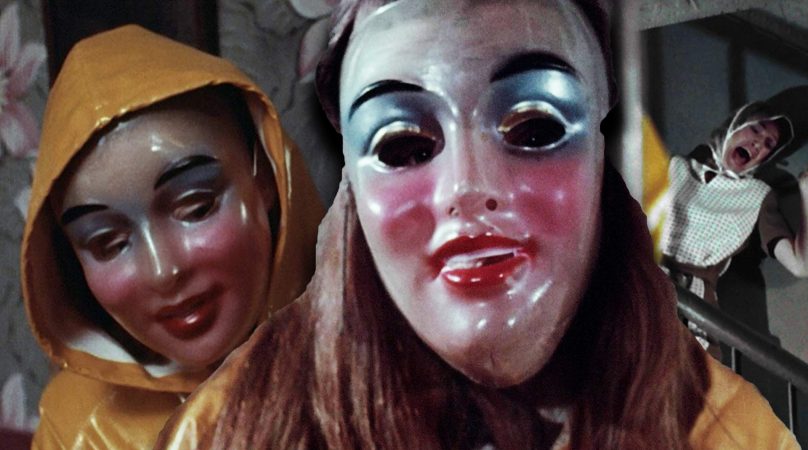
In 2020, almost from out of nowhere, masks have become a politically explosive subject in the context of the COVID-19 pandemic. Yet masks have an extraordinarily long history, containing great potency both culturally and socially, a subject of key interest for anthropologists and those in other fields of research. Horror cinema can reveal a great deal about the contemporary mechanics of masks and mask wearing in terms of how the genre has evolved since its earliest days to the present. As Alexandra Heller-Nicholas argues in her Bram Stoker Award nominated book Masks in Horror Cinema: Eyes Without Faces (University of Wales Press, 2019), three factors have long been at the core of how masks have endured so unrelentingly as extremely powerful cultural objects: the intersection of ritual, power and transformation. This talk maps the concept of the horror mask from ancient times to a range of different cultural and national contexts, including Japanese Noh theater and the Italian commedia dell’arte, turning towards its evolution in gothic literature and Grand Guignol theater in France, before focusing on film in particular. Beginning with early cinema, the lecture will provide a chronological tour of how the mask evolved and became such an enduring, ubiquitous, yet bewilderingly critically overlooked element of horror cinema iconography, leading to its codification in the genre from the early 1970s. Then, a loose taxonomy of different kinds of horror masks will be introduced: skin masks, blank masks, repurposed masks, animal masks, and technological masks. Across these categories, Heller-Nicholas will discuss a range of examples from horror movies from around the world with an emphasis as much on how the mask can deviate in its meaning and usage as it does present a coherent, consistent logic. But, at its heart, the presence of the mask remains mobilized around those three key concepts: ritual, power and transformation. What does this tell us about horror? What does this tell us about the cultures that produce and consume the genre? And what can it tell us about where we are today, where the very presence of the mask instantly speaks to very specific political affiliations and beliefs where masks are now a life or death matter?
Please note these are live events – they cannot be downloaded and watched later, so please be sure you are available at the time and timezone the classes are being offered in before registering.
Alexandra Heller-Nicholas is an Australian film critic, author, academic and festival programmer who has written eight books on cult, horror and exploitation cinema with a particular focus on gender politics. Her books include Rape-Revenge Films: A Critical Study (McFarland, 2011), 1000 Women in Horror, 1895-2018 (BearManor, 2020), the Bram Stoker Award nominated Masks in Horror Cinema: Eyes Without Faces (University of Wales Press, 2019), and monographs on Dario Argento’s Suspiria for Auteur’s Devil’s Advocates series, Abel Ferrara’s Ms. 45 for Columbia University Press, and Robert Harmon’s The Hitcher, published by Arrow Books. Alexandra has co-edited books on Elaine May, Peter Strickland, Alice in Wonderland in film, and Hélène Cattet and Bruno Forzani. She holds a PhD in Screen Studies and is an Adjunct Professor at Deakin University and a Research Fellow at RMIT University, as well as a member of the Alliance of Women Film Journalists. Alexandra is also a proud member of the advisory board for the Miskatonic Institute of Horror Studies.