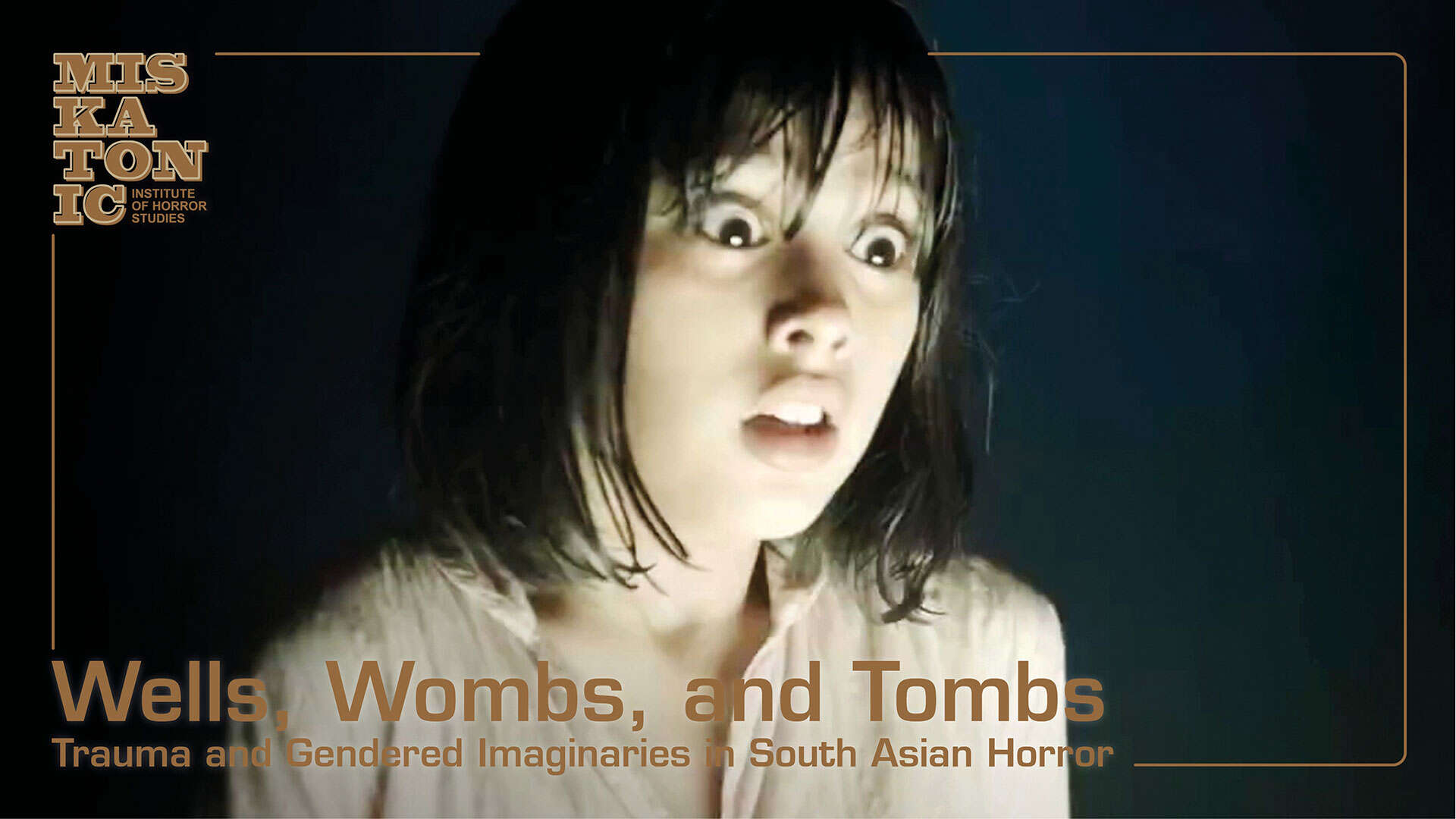
The most iconic image in the global horror hit RINGU (1998) is arguably that of a dead and sodden Sadako (Rie Inoo) climbing out of the grainy footage on a television set to kill the film’s male protagonist — a climactic sequence that echoes her equally terrifying emergence from the well earlier in the film. However, the water-well appears across Asian horror cinema as an overdetermined site of violence against women and the transgenerational transmission of historical traumas. Burdened with the symbolic weight of the vagina and womb, the well nonetheless functions as an index of both individual and collective tragedies.
In Indian horror films, the well inevitably invokes the historical catastrophe of the Partition, when hundreds of women either willingly committed mass suicides by throwing themselves into wells in rural areas or were brutally assisted in the act by kin and community. The well is probably the most potent affective image of the violence that women endured in the period that birthed the modern states of India and Pakistan. In this context, therefore, the well is never simply a metaphor for the fecund/abject female body, although it is always that too.
In this talk, professor and author Meheli Sen will perform a deep analysis of recent Indian horror films like KAALI KHUHI (2020), CHHORI (2021), and NEELAVELICHAM (2023) alongside earlier texts like RINGU to provide a generative framework for understanding the ways in which genre films continue to situate women and girls within a continuum of violence and precarity in non-western cinemas.
Meheli Sen is Associate Professor in the department of African, Middle Eastern, and South Asian Languages and Literatures, and the Cinema Studies program at Rutgers University. Her research area is post-independence Indian cinema, particularly Hindi and Bengali language films. She is especially interested in questions of gender, genre, modernity, globalization, and new media cultures. Her work has been published in journals such as Cinema Journal, Framework: The Journal of Cinema and Media, LIT: Literature Interpretation Theory, South Asian Popular Culture, among many others. She has co-edited an anthology titled Figurations in Indian Film (Palgrave-Macmillan, 2013). Sen’s book, Haunting Bollywood: Gender, Genre and the Supernatural in Hindi Commercial Cinema was published in 2017 by The University of Texas Press and Orient BlackSwan. She is currently working on a book manuscript focusing on horror, digital media, and political cultures in South Asia.