MIS
KA
TON
IC
Institute of
Horror Studies
Archive
Archive
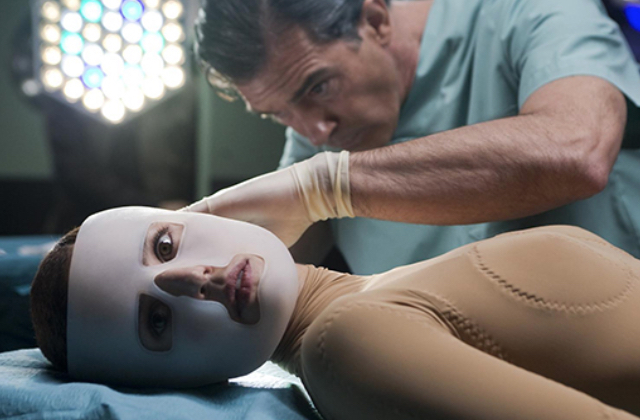
PROJECTING HORRORS REAL, IMAGINARY AND METAPHORICAL: TRANS AND OTHER GENDER-NON-CONFORMING BODIES IN HORROR CINEMA (LA Online)
Gender non-conformity has long been a marker in cinema for murderous villainy and psychosis or has been presented as reason enough for anyone thus marked to be dispatched from their narrative universes with excessive (and often casually misogynistic) force.
For transgender and gender-diverse people, everyday life can be the stuff of horror, ranging from the bureaucratically ontological – can you think of many other peoples the notionally most advanced of societies will attempt to legislate out of existence? – to enduring the constant background noise of the threat of violence, felt especially by trans people of color. A lot of screen media production, notwithstanding that it mightn’t all be read as “horror” by genre afficionadi, has only served, through stereotyping and ignorance, to perpetuate the real traumas and horrors experienced routinely by trans people.
Necessarily then this lecture will debunk no small number of harmful myths about transgender people propagated by the screen media-industrial complex and in the horror movies historically produced within it. But that’s not all…
We’ll explore the ubiquity of trans narratives and imagery within horror cinema – even if they’ve most often been deployed at a metaphorical remove from being transgender narratives and imagery, per se.
Horror films concerned with body dysmorphic conditions – whether blights borne upon the surface of a body, or of mutilation or recombination of its constituent parts, inside, outside or inside-out… or concerned with unsought-after metamorphoses from causes natural, surgical or supernatural, and even possession narratives – all can be read as allegories for gender dysphoria…
Frankensteinian narratives, which long pre-date the availability of gender affirmation surgery for those who seek body modifications to reconcile their sense of self with their corporeal housing, present even more points of metaphorical intersection, between horror cinema and trans lived experience, to dissect.
We’ll move beyond the metaphorical and also celebrate the increasing participation of transgender people behind and in front of the camera, pausing to unpack challenges posed by the latter development. Trans performers and characters often appear only for a film to foreground their transness; a trans identity is very seldom secondary. But here’s the rub: even when it doesn’t matter, it matters. Take Bit (dir. Brad Michael Elmore, 2019): a 21st century Lost Boys for a kyriarchy-sensitized viewership which features trans actor Nicole Maines as a protagonist whose gender identity is never problematized – what a blessing! But… perhaps also a curse, in that, while transness has been rendered visible (a trans actor in a lead role!), hers is simultaneously invisible (her transness is erased narratively, and many viewers mightn’t apprehend that the actor is trans). Can any of us truly be what we can’t see?
Please note these are live events – they cannot be downloaded and watched later, so please be sure you are available at the time and timezone the classes are being offered in before registering.
Cerise Howard
27 May 2021
Read more
27 May 2021

CHRONICLE OF A DEATH FORETOLD: SPOORLOS (NYC Online)
Adam Nayman
20 May 2021
CHRONICLE OF A DEATH FORETOLD: SPOORLOS (NYC Online)
On a biking holiday with her boyfriend Rex, spirited, impulsive Saskia relates her childhood dream of being imprisoned in a golden egg, floating through the universe. Her anecdote turns out to be a chronicle of a death foretold. George Sluizer’s brilliant 1988 thriller Spoorlos unfolds as a series of prophecies, including several of the self-fulfilling variety: its characters can envision the consequences of their actions but pursue them anyway. After Saskia disappears from a roadside rest stop, Rex is consumed by a need to know what happened to her, a slave to his own morbid curiosity. In a parallel storyline, a prosperous chemistry professor strives to control and channel his own involuntary compulsions.
Where many genre films utilize the element of surprise, Spoorlos is constructed so that its characters—and the audience—can see everything coming. This creeping, inescapable dread makes Sluizer’s film a classic—Stanley Kubrick called it the scariest movie he’d ever seen— and gives it a genuinely existential dimension. In this brand-new lecture, film critic and author Adam Nayman (It Doesn’t Suck: Showgirls; Paul Thomas Anderson: Masterworks) will analyze how Spoorlos plays with various literary and dramatic conventions from its shivery, premonitory prologue to its startling, retrospectively inevitable climax, while also examining its relationship to various cinematic influences (including Vampyr, Psycho and The Shining). In addition, the lecture will include a comparison of Spoorlos with its 1993 American remake The Vanishing—a curious and baffling case of a European filmmaker reworking and arguably disfiguring his own material in a Hollywood context.
Please note these are live events – they cannot be downloaded and watched later, so please be sure you are available at the time and timezone the classes are being offered in before registering.
Adam Nayman
20 May 2021
Read more
20 May 2021
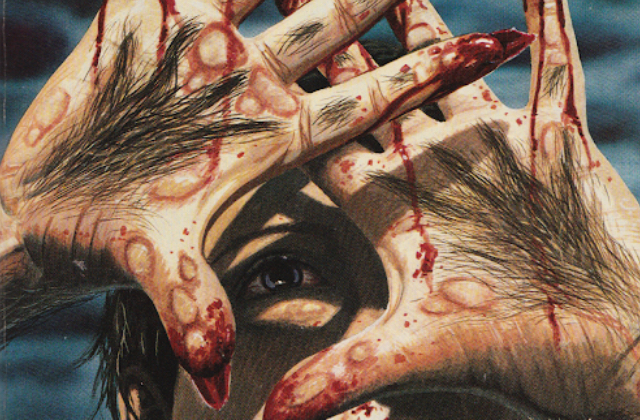
LESS PUNK, MORE SPLATTER: THE HARD ROCK HORROR FICTION OF SHAUN HUTSON (London Online)
Johnny Walker
11 May 2021
LESS PUNK, MORE SPLATTER: THE HARD ROCK HORROR FICTION OF SHAUN HUTSON (London Online)
In Britain, the books of horror novelist, Shaun Hutson, were at one time outsold only by those of Stephen King. Yet despite his success, Hutson’s work has never been subject to extensive scholarly appraisal. This is due, at least in part, to the literary value Hutson’s work is said to lack, and the disdain directed towards him by his (critically revered) contemporaries. Clive Barker, for example, is alleged to have referred to Hutson’s work as “irresponsible”, while Ramsey Campbell has accused Hutson on more than one occasion of “dragging horror into the gutter”. Politically ambivalent and morally conservative, Hutson’s writing also lacks the socially-charged impulse and cultural nuance characteristic of acclaimed authors such as James Herbert. So what, then, is interesting about Shaun Hutson’s oeuvre, if, by the author’s own admission, “greed is [his] main motivator” and his books aren’t “about anything”?
This illustrated lecture explores this question and others, offering an assessment of Hutson’s novels during his most prolific decade, the 1980s. It will offer an overview of the “literary nasties” phenomenon sparked by the publication of Herbert’s The Rats – and imitators such as Guy N. Smith’s Night of the Crabs – to establish the context from which Hutson’s writing emerged. It will be argued that novels such as Slugs (1982), Spawn (1983), Erebus (1984), Chainsaw Terror (1984), Relics (1986) and others operate as pop-culture barometers that are reinforced by Hutson’s cult celebrity status in the contemporaneous horror and rock music press. A self-confessed super fan of the band Iron Maiden and avid cinemagoer, one finds in Hutson’s work epigraphs from hard rock acts such as Saxon, Dio, Queensrÿche and of course Maiden itself, juxtaposed against writers as diverse as Nietzsche and Lovecraft, while his books are said to read “as screenplays” and are indebted to popular cinema in numerous ways. The talk maintains that Hutson’s novels and celebrity function in a similar matter to “shock rock” acts such as Kiss and video nasties – whereby style is said to prevail over substance, and therein lies the appeal.
The talk will be lavishly illustrated, feature extended quotations, clips from interviews, as well as contemporaneous horror films to assess the lasting significance of – as Kerrang magazine had it – “The Shakespeare of Gore.”
Please note these are live events – they cannot be downloaded and watched later, so please be sure you are available at the time and timezone the classes are being offered in before registering.
Johnny Walker
11 May 2021
Read more
11 May 2021
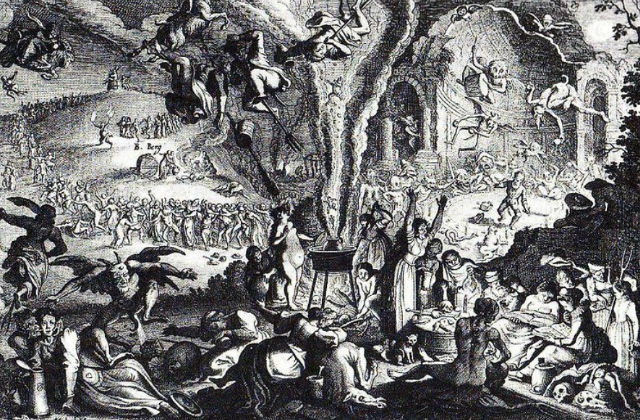
WALPURGISNACHT: FOLKLORE & POPULAR CULTURE (LA Online)
Mikel J. Koven
29 April 2021
WALPURGISNACHT: FOLKLORE & POPULAR CULTURE (LA Online)
Walpurgisnacht, the evening of the 30th of April, is said to be one of the holiest days of witch’s calendar; the night before the feast of Saint Walpurga, who drove the witches out of Germany. Anton LaVey, the founder of the Church of Satan, declared Walpurgisnacht one of the holiest days of the Satanic year. It was said that on this evening, covens of witches would gather on Brocken mountain in Northern Germany, to weave their nefarious evil. This class explores the folklore surrounding Walpurgisnacht and its representation in popular culture, including the poetry of Goethe, the music of Mendelssohn, the folk rock/folk metal sounds of Faun, and of course the films of Paul Naschy. How does all this fit together? Only the witches know and will reveal all on Walpurgisnacht 2021.
Please note these are live events – they cannot be downloaded and watched later, so please be sure you are available at the time and timezone the classes are being offered in before registering.
Mikel J. Koven
29 April 2021
Read more
29 April 2021
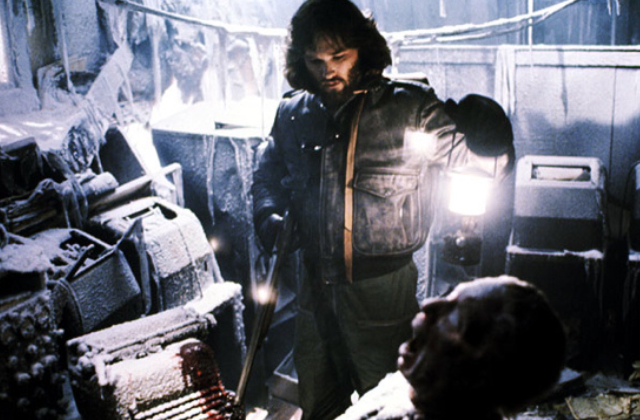
THE HOLLOW THE IMAGE LEAVES EMPTY: ALTERITY, ABJECTION, & THE THING (NYC Online)
Shelagh Rowan-Legg
22 April 2021
THE HOLLOW THE IMAGE LEAVES EMPTY: ALTERITY, ABJECTION, & THE THING (NYC Online)
In his treatise on psychoanalysis, Jacques Lacan makes reference to das ding, a king of thing-presentation that is the thing in its dumb reality, the beyond of the signified. Similar to Emmanuel Kant’s theory of the thing-in-itself, das ding is the Other in absolute alterity, outside language and mainly characterized by the fact that, for Lacan, “it is impossible for us to imagine it”; in its dumb reality; it cannot be assimilated through identification. In her essay “Powers of Horror,” Julie Kristeva, “The abject has only one quality of the object—that of being opposed to I;” the abject is exclusion, in a place without meaning, and from that place it cries out in revolt and brutish suffering. This is the essence of horror: that which can be neither known nor named; without identification, we cannot seek to fight and free ourselves, and are destined to become that horror which we cannot know.
These concepts of alterity and abjection have frequently been used in horror texts. In John Carpenter’s 1982 horror-science fiction film The Thing, a group of men at an Antarctic research station, find themselves under attack by an alien. However, the alien’s true form is never known, as it instead attempts to assimilate itself inside the bodies of the living creatures it finds, thus remaining an unknown monster both outside human language and without its own language. This, perhaps, is the true face of horror:, in a place devoid of life and unreachable, where the monster is at once unnameable, unknowable, and yet frighteningly familiar. Is the alien, and by extension the men, an embodiment of das ding, the true nature of absolute alterity, and at the same time also the abject, lost in a place devoid of meaning, left to languish in exclusion from the human race?
Through the lens of The Thing, and other texts such as Planet of the Vampires and It, this class will examine the horror where alterity and abjection meet. If, as Kristeva writes, the cause of abjection is that which disturbs order and identity, then horror stems from that which cannot be identified, the alterity of the other.
Please note these are live events – they cannot be downloaded and watched later, so please be sure you are available at the time and timezone the classes are being offered in before registering.
Shelagh Rowan-Legg
22 April 2021
Read more
22 April 2021
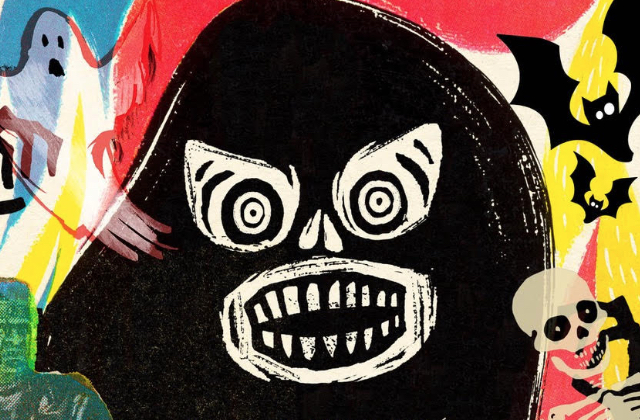
THE MONSTER MASH: REMIX HORROR FROM THE MAGIC LANTERN TO THE SMALL SCREEN (London Online)
Megen de Bruin-Molé
13 April 2021
THE MONSTER MASH: REMIX HORROR FROM THE MAGIC LANTERN TO THE SMALL SCREEN (London Online)
From magic lantern phantasmagoria to Universal Classic Monsters to Pride and Prejudice and Zombies, the monster mash has always been a popular subcategory within horror. But what makes a mash-up? The terminology comes from music, but remix horror can be found in film, literature, television, and many other media. In form, mash-ups are the Gothic ‘monsters’ of our age—hybrid creations that lurk at the limits of responsible consumption and acceptable appropriation. Like monsters, mashups offer audiences the thrill of transgression in a relatively safe and familiar format. And like other popular texts, mashups are often read by critics as a sign of the artistic and moral degeneration of contemporary culture.
This talk will focus on three key moments in the history of the monster mash, beginning by briefly exploring Gothic traditions of mashup and intertextuality in 18th-century novels. These texts and techniques are taken up in magic lantern performances and other media. Next we will link these practices to a discussion of Universal Studios, who industrialized and commercialised the monster mashup in films like Frankenstein Meets the Wolf Man (1943), The House of Frankenstein (1944), and Abbott and Costello Meet Frankenstein (1948), paving the way for later film franchises to capitalise on remix techniques and shared universes. Universal’s Monsters also prefigure the horror of the more recent literary mashups and ‘Frankenfictions’, our third and final example. From Anno Dracula (1992) and The League of Extraordinary Gentlemen (1999-2019) to Hotel Transylvania (2012) and Penny Dreadful (2014-2016), the monster mashup is everywhere in the twenty-first century, manifesting in new and interesting ways. While we can certainly see similarities between all these examples, each also has its own origins and copyright histories in different media.
What has taken this genre from the margins to the mainstream? For the most part monster mashups remix not to transform, but to highlight a frighteningly unchanging status quo—reminding us that Gothic fears ultimately ‘derive from our inability to convince ourselves that we have really escaped from the tyrannies of the past’ (Baldick 1992, xxii). Despite (or perhaps because of) their derivative natures, there is a lot these texts can teach us about the history of the horror industry. Repetition and recombination can have a critical function, indicating when a particular theme, form, or interpretation has begun to lose its power. Amidst a twenty-first-century resurgence in cerebral, original horror, monster mash-ups may not seem to offer any meaningful commentary on our socio-political reality, but as each of the examples in this talk will show, they can help us to reveal and remix the most fundamental structures of the status quo.
Please note these are live events – they cannot be downloaded and watched later, so please be sure you are available at the time and timezone the classes are being offered in before registering.
Megen de Bruin-Molé
13 April 2021
Read more
13 April 2021
AN ORGY OF TERROR: ITALIAN HORROR COMICS OF THE 1970S AND 80S (LA Online)
Adam Twycross
25 March 2021
AN ORGY OF TERROR: ITALIAN HORROR COMICS OF THE 1970S AND 80S (LA Online)
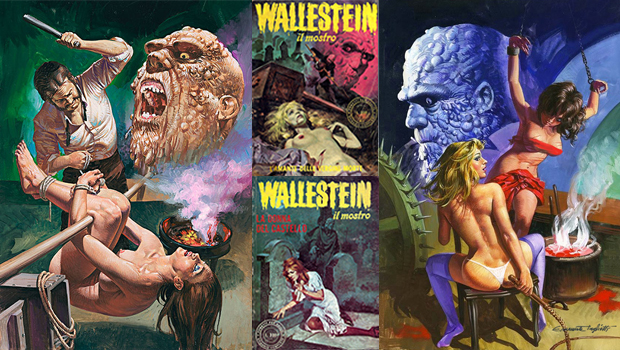
During the 1970s and 80s the field of comics erotica in Italy burst dramatically to life, swiftly developing into a diverse field that straddled a range of genres including horror, crime, adventure, and comedy. Perhaps the most successful of these comics were those developed by Edifumetto, a Milanese publishing house established by Renzo Barbieri in 1972. At its height, Edifumetto was publishing hundreds of individual titles and selling millions of copies every month, with their comics appearing across Europe, Central and South America, North Africa and French-speaking Canada. Typically appearing as small-format pocket digests, these comics were notable for their lushly painted cover art which featured work by some of Italy’s finest illustrators, including Alessandro Biffignandi and Emanuele Taglietti. Significant also were the explicitness of their themes and imagery, with storylines that blended nudity and sex with violence so gratuitous that it occasionally bordered on parody.
Although active across a range of genres, perhaps the most visually and thematically dramatic of Edifumetto’s comics were their horror titles, which included Wallestein il Mostro, Zora la Vampira and Sukia. This was a publishing genre in which the classic and the contemporary collided; deserted cemeteries and ruined castles played host to tales of depravity and madness that blended seamlessly with a world of fast cars, guns and glamour. Today these comics survive as a powerful record of a unique flowering of adult comics horror whose visceral and stylish intensity remains unmatched anywhere in the world.
This talk will discuss these extraordinary comics from a cultural and historical standpoint, examining both the transnational context within which they evolved, and the uniquely Italian environment that shaped their development. Their links to the wider media landscape will be considered in detail, allowing for a full understanding of the position that they occupied within the popular cultural environment to emerge. Their relationship to developments in the international comics market, especially the growing trend for transnational practices of production and distribution, and an increasing acceptance of adult and erotic content across much of the western world will also be discussed. Finally, the talk will examine the close stylistic and thematic links that bound comics such as Wallestein to contemporary trends in Italian cinema, and especially to developments in the giallo and horror genres and films such as Dario Argento’s Suspiria and The Bird with the Crystal Plumage and Mario Bava’s Blood and Black Lace.
Please note these are live events – they cannot be downloaded and watched later, so please be sure you are available at the time and timezone the classes are being offered in before registering.
Adam Twycross
25 March 2021
Read more
25 March 2021
CONCRETE MATERNALITY: ON LATE CAPITALISM AND HIGH RISE HORROR (NYC Online)
Émilie von Garan
18 March 2021
CONCRETE MATERNALITY: ON LATE CAPITALISM AND HIGH RISE HORROR (NYC Online)
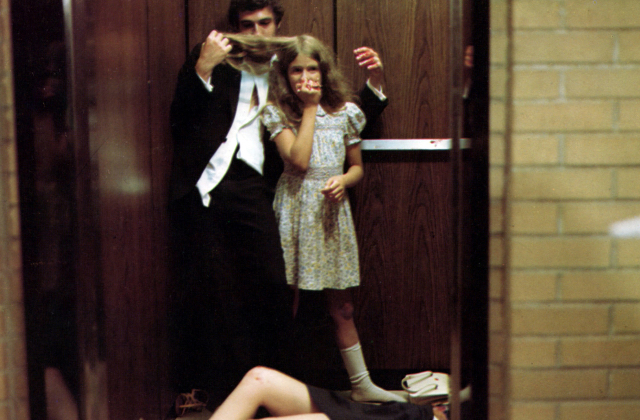
In her book on the role of gender in the modern horror film, Carol Clover discusses how the female body often translates as a metaphoric architecture for cinema, arguing that its penetrable yet opaque interiority becomes a perfect site for housing anxieties, fears, or what one would deem, following Freudian theory, the uncanny. This potentially disturbing correspondence between the uncanny feminine and architectural interiority finds its most overt articulation in horror films that take residential towers as their setting, with the precarity of female bodies highlighting the terrors that they give rise to. We see this in numerous horror films from the late 1960s until the present. This lecture focuses on the coupling between residential towers and threatening and/or threatened female bodies in two films—David Cronenberg’s Shivers (1975), and Bernard Rose’s Candyman (1992)—locating in each productive engagements with different stages of neoliberalism and urban development.
Negotiating the complex legacy of the association of the home with the realm of the feminine, we will think through questions of gendered representation via the concept of concrete maternality, which alludes to the residential tower as a new site that incubates anxieties related to the late capitalist transformation of social relations and its gendered formulations of unhomeliness. Specifically, as we look at the treatment of the residential high-rise as womb-like, we will come to understand the building as concrete, objective in its materiality, while envisioning its interiors to be experiential/embodied, thus open to subverting the logic of late capitalism from within. In other words, examining bodily and gendered analogies in architecture will enable us to reflect on the various ways sites and sights of horror directly relate to broader cultural trends and economic policies. Finally, we will reflect on the legacies of these films and turn to more recent productions that explore similar issues.
Please note these are live events – they cannot be downloaded and watched later, so please be sure you are available at the time and timezone the classes are being offered in before registering.
Émilie von Garan
18 March 2021
Read more
18 March 2021
HAMMER GOES TO HELL: THE HOUSE OF HORROR’S UNMADE FILMS (London Online)
Kieran Foster
9 March 2021
HAMMER GOES TO HELL: THE HOUSE OF HORROR’S UNMADE FILMS (London Online)
The British Film Studio Hammer Films is perhaps one of the most iconic film studios of all time. Hammer’s production of gothic horror pictures began in 1957 with The Curse of Frankenstein, and would go on to cement a lasting house style for the company and international success. This success has led to the company being extensively documented both within and outside academia. Yet a crucial area of the company’s history remains largely unexplored.
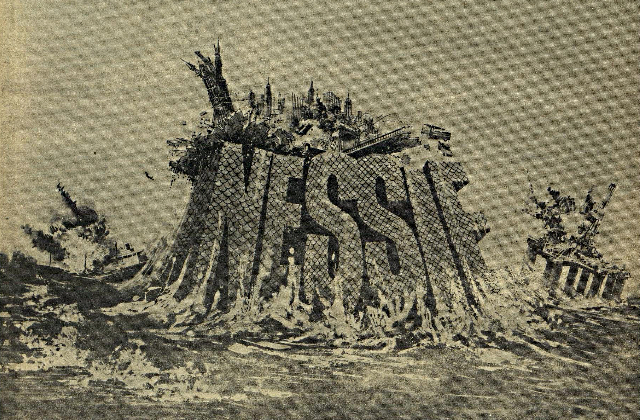
This talk will utilise never seen before archival materials held in the Hammer Script Archive to present a new perspective on Hammer Films. The talk will argue that whilst many studies of Hammer Films have been undertaken, none have accounted for the significant amount of creative and economic labour that went into over 100 unmade projects at the company. Utilising primary materials such as screenplays, financial documentation and correspondence, the talk will examine the industrial and production contexts of an eclectic range of Hammer’s unmade films, ranging from Loch Ness Monster project Nessie to Dracula in India script Kali Devil Bride of Dracula.
Through an examination of these lost projects, the talk will therefore look to address a crucial gap in the history of Hammer Films via their unmade projects. Foregrounding Hammer’s unmade texts in this way also necessitates a shift away from the typical analysis of Hammer’s stars or the film’s visual style, and instead allows for an examination of the methods of production and the creative roles of the managing director, producer and screenwriter. For example Michael Carreras was Managing Director of Hammer between 1971–1979, and materials on Hammer’s unmade projects create a detailed picture of his tenure in charge of the company.
As well as the Hammer Script Archive, the talk will utilise materials held at the BFI archive, the Margaret Herrick Library and the Warner Bros Archive in Los Angeles to refute key narratives surrounding Hammer’s demise, which often centre on creative stagnation. Instead the talk will suggest that Hammer’s unmade projects demonstrate exceptional creative innovation, even in the final years before their closure in 1979. It will argue that it was key tensions within Hammer, as well as larger industrial changes to the British film industry, which ultimately sealed the company’s fate.
Please note these are live events – they cannot be downloaded and watched later, so please be sure you are available at the time and timezone the classes are being offered in before registering.
Kieran Foster
9 March 2021
Read more
9 March 2021
RICK BAKER: AN INTIMATE SELF-PORTRAIT (LA Online)
Amy Voorhees Searles
25 February 2021
RICK BAKER: AN INTIMATE SELF-PORTRAIT (LA Online)
“Now Rick has come full circle—in “retirement,” he’s as busy as ever, working on a wide range of projects at home. He says it feels like being a kid again.” – Peter Jackson
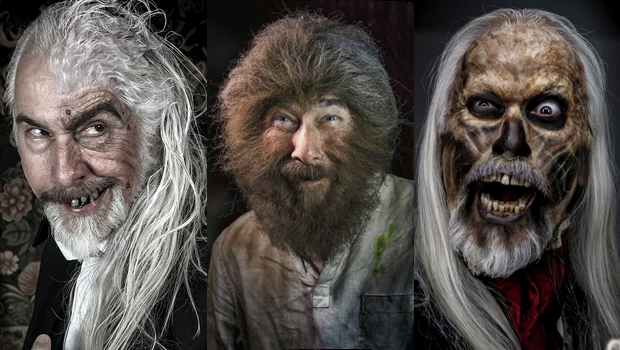
Rick Baker is a world-renowned titan of the film industry whose curriculum vitae glitters with Oscar® gold, having won a record 7 Academy Awards® for Best Makeup over the course of his career, but his beginnings likely resemble many of our own. As a taciturn “monster kid” who whiled away youthful hours gleefully poring over love-worn copies of Famous Monsters of Filmland, reverently drawing images of his favorite horror stars, and customizing Aurora model kits, Baker found that his idiosyncratic affinities made him something of a misfit. Through diligent research and exhaustive trial and error, Baker’s hobbies evolved into his life’s passion, as he incorporated mask-making and makeup into his creative world. Upon initial experimentation with makeup on himself, Baker recalls, “I sat in front of a mirror, but the reflection was not my face. It was no longer me. It was the face of a hideous vampire. Suddenly, I felt free. . . . I was hooked. I had to do more makeups. I wanted to look like my favorite monsters. On that day, my life was changed.” Although he was a shy adolescent, the transformative qualities of makeup emboldened Baker to dabble in the performative and the outrageous. Though seemingly contradictory, donning these eerie exoskeletons of his own design are precisely what enabled Baker to come out of his metaphorical shell.
Makeup artists are known for testing their trade on themselves – they are, after all, their most reliable test subject – but Rick Baker’s personal relationship with transformation is clearly more than one of convenience. It is immediately obvious from Baker’s lavishly illustrated biography, Metamorphosis, and from his endlessly entertaining Instagram account, that Baker delights in applying makeup to himself. With a career as storied and varied as his, Baker has a unique perspective on the psychology of physical change to share with us.
Miskatonic Los Angeles is deeply honored to host a conversation with the living legend himself, Rick Baker. Utilizing Baker’s self-portraits in the medium of monsters as our guide, we will track his personal and professional metamorphoses: from a boy to a man, and from a novice to a master.
Please note these are live events – they cannot be downloaded and watched later, so please be sure you are available at the time and timezone the classes are being offered in before registering.
Amy Voorhees Searles
25 February 2021
Read more
25 February 2021